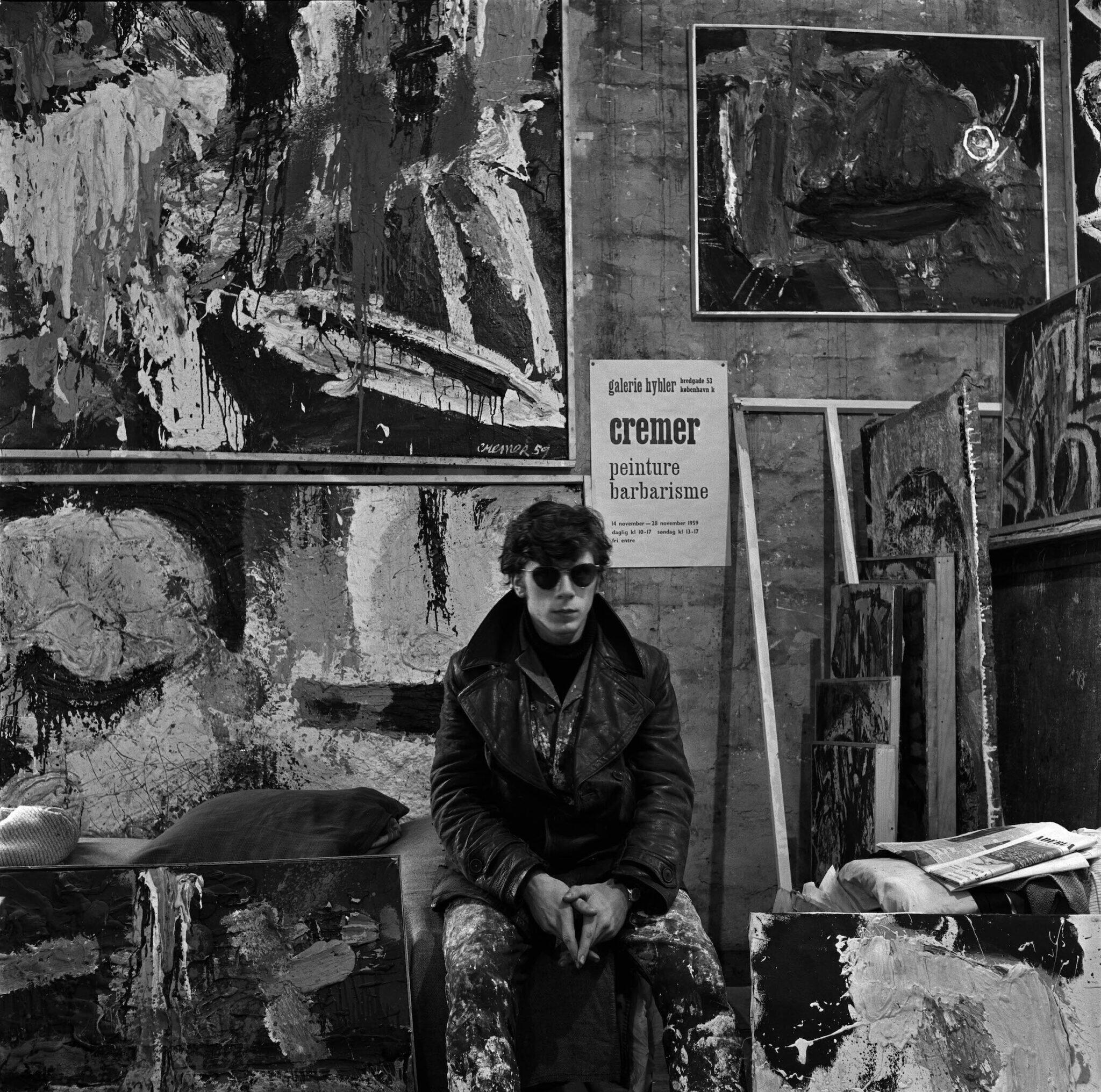
Jan Cremer is among the most important creators in our collection. With his double talent as a painter and writer and his rebellious attitude in both disciplines, he had a huge impact.
Jan Cremer (1940 - 2024), born on 20 April 1940 in Enschede, attended art education in Arnhem and The Hague and left in 1959 for Paris, then the most important centre of art and culture in Europe. In Paris, he developed his so-called 'Peinture Barbarisme' , with expressive gesture painted canvases with thick layers of paint mixed with sand, jute and other materials. With his unorthodox technique and ditto personality, he instantly placed himself at the centre of modern art.
In 1961, Cremer left the metropolis Paris (where he did keep a studio) for remote Ibiza. The scorching sun and rugged landscape led to a series of works that almost look Japanese in their incisive writing. They show how painting and writing can be an extension of each other and sometimes overlap. With Cremer, this was literally the case. The publication of his no-holds-barred picaresque novel Ik Jan
Cremer in 1964 shocked the cultural elite in the Netherlands. With the proceeds of this 'unrelenting bestseller', which was later translated into dozens of countries, he settled in the Chelsea Hotel in New York. There he began painting again, this time not abstract canvases full of paint but expressive and colourful fields of tulips. Cremer's incorporation of the Dutch cliché image par excellence may be seen as a connection between the pure painting of Paris and Ibiza with the great Dutch landscape tradition on the one hand and the anti-traditional pop art of New York on the other.


manifesto
The manifesto written by Jan Cremer and Jan Wesseling in 1959 walking on damaged legs - manifesto on cremer's peinture barbarism forms one of the starting points of the exhibition:
walking on damaged legs
manifesto on cremer's peinture barbarism
a ferocious beast
he works within the soft flesh of the night. he has the mutinous mane of a barbarian. he listens to the silence in which the clockwork of his fear skips many beats. this goes far.
we empty the little glasses and fill them again. there is music. art blakey builds his message in the barren plain of our hearing. (behold the little beetles creep under, in the sky dwells man's impotence, we no longer count the drinks). we go beyond the voice. we talk a break between the aged layers of your skin. we say it's a mess that the museums hang full of it. we laugh at the old mouldy wealthy gentlemen who carefully rub the paint off their fingers, polish their bedraggled glasses, die. (we are the ferocious wolves, we breathe in their affluence intently, we no longer count the drinks). we puke at the blood-poor bleeders of their aesthetic gijnts, their well-cut heads of their snazzy costumes. they have the nimble fingers of a prosituee. we go beyond the breath smell. we empty the glasses and fill them. the barbarist says 'there must be something new, the great the insane. we will drink the impotence from the skulls of the half-souls'. he says 'we have had enough of their delicate compositions their refined gamut of colours. it's all rubbish, estetika. i sodemite paint on a canvas, i drip splash kick. I fight with paint, sometimes I win'.
because oh we sing it sometimes we scream it sometimes in your sacred houses. not we want the small happiness not the small experience not the industrious tessellations of the boys with the meccano boxes. the big the insane. the naked emotion with the tattoos of madness. we empty the glasses and fill them again. the white liquid we pour into our beaks. we are the great birds of prey and soar above the salty child of your silence. the barbarians rip the guts out of your body. they accompany themselves on the drums of your anxiously sweating forehead. they demolish the temples of your deficiency. the barbarian says 'behold the beetles become great angry beasts. they move their saliva and turn their emotions into paint'. he wields the dead wood of his birth and builds a cathedral. like a steel of light, he pounces on the canvas and kills understanding because understanding goes beyond powerlessness. he towers over you. his wrath is fierce.
we empty the glasses and fill them again.