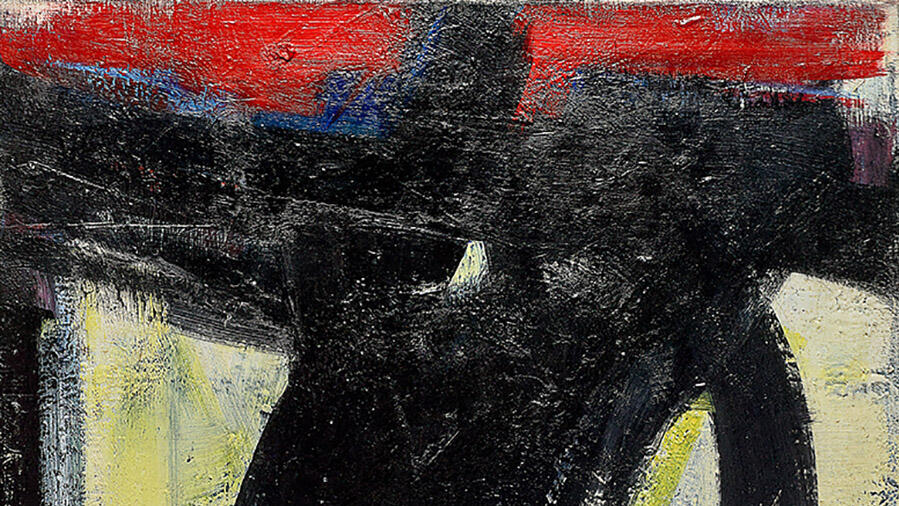
05-12-2019 - Museum de Fundatie has bought Untitled by Theo Wolvecamp. The 1964 painting is an important work in Wolvecamp's oeuvre because it marks his final departure from figuration.
This work forms the link between three other paintings by Wolvecamp in the museum's collection: Insect from 1950 and Without Title from 1979 (both collection Provincie Overijssel) and Bird and Prey from 1957 (long-term loan from the Rijksdienst voor het Cultureel Erfgoed).
Theo Wolvecamp (1925-1992) was co-founder and member of Cobra and returned to his native Twente after living in Paris in 1954. He felt too connected to nature to be able to ground himself in big cities. In seclusion and from a strong perception of his surroundings, he developed a very personal style of painting. From the improvisationally colourful working methods of Cobra in the 1950s, with references to Miró and Kandinsky, he developed in Hengelo into perhaps the Netherlands' most important abstract expressionist. Indeed, he discovered the new American art, which had not previously been known in Europe due to the isolation of the war, and noticed that painters there were undergoing the same kind of development as in the Netherlands. Wolvecamp is impressed by American Expressionists such as Jackson Pollock, Arshile Gorky and Franz Kline. He gets into their skin and in the resulting work he regularly refers to his fellow overseas painters, always with very distinctive shapes and colours of his own. For Wolvecamp, the struggle with matter is central, and symbolism and mysticism are important to him, but he never provides paintings with explanations or meaning.
In this 1964 work, Wolvecamp has painted characters reminiscent of the abstraction of Pierre Soulages and Franz Kline. The work is spatial, painted with black lacquer on a light ground of mixed white, yellow, blue and red. 'I needed the grand gesture, because I could no longer control the capriciousness of the form. Painting had become too complicated I couldn't figure it out. So I started looking for a landscape space. It was more of an experiment for myself,' the artist says of this period. Wolvecamp never went public with the expressive signs, often painted on the ground. He was highly critical of his own work and paintings left his studio sparsely. This painting comes from a Parisian private collection and was acquired through Lennart Booij Fine Art and Rare Items. The work is a valuable addition within the Fundatie's museum collection and compares excellently with Karel Appel, Jan Cremer, Lynn Chadwick and Antonio Saura.
"I start with a spot of colour, with the subject matter; I don't know where I will go. I improvise, and under the almost automatic act of painting I begin to feel free. When I paint, I do not criticise what I have done; that comes later. The suggestion that emanates from the material spurs creativity into action. It is the encounter with raw matter that suggests the forms and ideas to me. In the flow of a spontaneous sense of life, what lives in you takes shape. In inspiration and whimsy like that, I don't believe. I see activating the urge to create as my main task." - Theo Wolvecamp, 1961
